
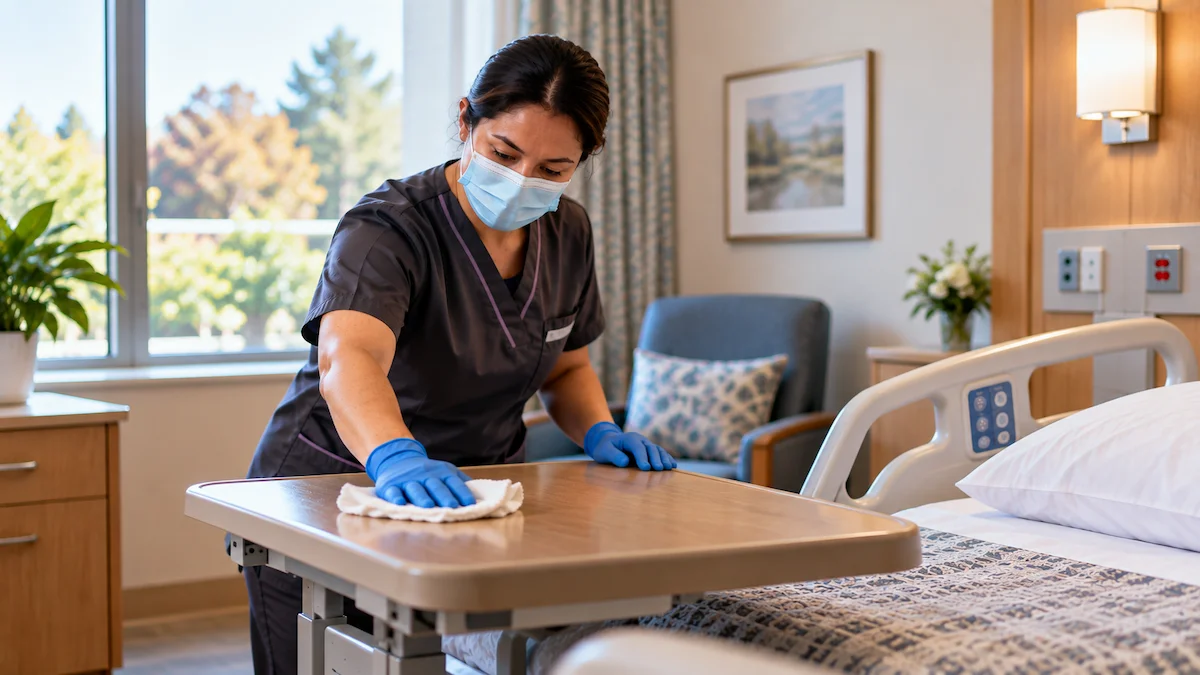
If We Want Better Infection Prevention in LTC, We Need to Stop Treating EVS Like a Cleaning Service

Environmental services is often described as a cleaning service in long-term care. The department cleans resident rooms, washrooms and common areas, manages waste and responds when additional cleaning is required. All of that is true, but I think describing EVS only in terms of cleaning seriously understates its role.
Environmental services is part of our frontline defence against infection.
The environment around our residents is constantly being touched, used and contaminated, which means the way that environment is cleaned has a direct relationship with infection prevention. If we truly believe environmental cleaning is part of infection prevention, then we need to manage it that way. That means going beyond cleaning schedules and task lists, bringing EVS into our IPAC conversations, improving how we educate staff, looking much deeper at what we audit, building real quality improvement around the findings and making sure the staffing model gives people a realistic opportunity to do the work we expect from them.
Otherwise, we may be optimizing a cleaning service when what we really need to be strengthening is infection prevention.
IPAC and EVS need to stop working in silos
IPAC and environmental services overlap constantly, yet in some organizations they can still operate like two separate programs. IPAC focuses on surveillance, outbreaks, hand hygiene, PPE, Additional Precautions and education, while environmental services focuses on rooms, schedules, cleaning products and staffing.
The problem is that infections do not respect departmental boundaries.
If a resident develops infectious symptoms, environmental cleaning matters. If Additional Precautions are initiated, environmental cleaning matters. If a high-touch surface is repeatedly missed, environmental cleaning matters. If a disinfectant is being used incorrectly, environmental cleaning matters. If shared equipment is not being cleaned between residents, environmental cleaning matters.
That is why I think EVS needs a much more meaningful place at the IPAC table. We should be talking together about environmental-cleaning audit results, recurring gaps, trends, outbreak challenges, product concerns and barriers staff are encountering, and we should be doing it with the same level of seriousness that we apply to other parts of the IPAC program.
Think about the typical IPAC committee discussion. We may spend significant time reviewing hand-hygiene compliance, PPE findings, surveillance trends and outbreak activity, but how much time are we spending looking at environmental-cleaning performance in the same depth? Are we reviewing repeat findings? Are we asking EVS leadership what they are seeing? Are we looking at whether particular units, shifts, practices or surfaces repeatedly create problems? Are we involving EVS in determining what needs to change?
If the answer is no, then EVS is still sitting too far in the background.
This collaboration should also go both ways. IPAC needs to understand how environmental services actually performs the work, while EVS needs enough infection-prevention knowledge to understand the principles behind that work. One department brings expertise in transmission and infection prevention, the other brings expertise in cleaning operations, workflow, products and the realities of performing the work every day; the opportunity is in putting those perspectives together rather than expecting one department to audit the other from a distance.
Stop teaching only what to do. Teach why we do it.
Environmental-cleaning education can very easily become procedural: start here, clean this surface, change the cloth, use this disinfectant, allow the appropriate contact time, move to the next area.
Those instructions matter, but I do not think they are enough.
If we want environmental services staff to make good decisions when the situation is not perfectly described in a procedure, they need to understand some of the infection-prevention reasoning behind what we are asking them to do.
Take something as simple as changing a cleaning cloth. A staff member could reasonably ask: if I am dipping the cloth into disinfectant that is designed to kill microorganisms, why can’t I keep putting the same cloth back into that solution?
If our education only said, “Don’t double-dip,” then the person knows the rule but may not understand the problem. Once they understand that a used cloth can introduce organic material and microorganisms into the solution, and that the goal is to prevent the cleaning process itself from spreading contamination from one surface or resident environment to another, the instruction starts to make much more sense.
The same applies to cleaning progression. We can tell staff to work from less contaminated areas toward more contaminated areas, but understanding why that sequence matters helps them apply the same principle when the exact room or situation looks different from the training example. Current PHO environmental-cleaning guidance supports this progression, and its audit tools also treat separate bed spaces within a multi-bed room as separate resident environments, including changing gloves, performing hand hygiene and using a new cloth when moving between those bed spaces.
That is where teaching the “why” becomes important. Staff will inevitably encounter grey areas that were not specifically covered during orientation, and they will also encounter busy days where the easiest way to complete the task may not be the best way to prevent cross-contamination. If someone only knows the rule, they may struggle when the situation changes; if they understand the principle behind the rule, they have a much better foundation for making the right decision.
Environmental services staff do not need to become infection-control professionals, but they should understand enough about infection prevention to know why the work they perform matters.
If IPAC is only auditing hand hygiene and PPE, we are scratching the surface
Hand hygiene and PPE deserve our attention, but they cannot become the entire IPAC audit program.
Environmental cleaning has its own practices that need to be observed, assessed and improved. Is cleaning progressing appropriately from less contaminated areas toward more contaminated areas? Are staff changing cloths when they should? Are separate resident bed spaces being treated as separate environments? Are high-touch surfaces being addressed? Are shared items being cleaned between residents? Are staff using products according to the manufacturer’s directions? Are the responsibilities between nursing and environmental services actually clear?
This also raises an uncomfortable question for IPAC professionals: do we understand environmental cleaning well enough to audit it properly?
If the answer is no, then that is an education opportunity for us too.
We cannot expect environmental services staff to demonstrate increasingly sophisticated infection-prevention practices while IPAC only checks the most visible elements. If we want EVS to function as part of our frontline infection-prevention program, then our own understanding and auditing need to go deeper as well.
The same principle applies to disinfectants. It is not enough to see a staff member using the correct-looking bottle, because how the product is used matters. That should change the kinds of questions we ask during audits. Does the staff member know the required contact time? Can the surface actually remain wet for that period? Do they understand when a different product is needed? Is the product practical for the workflow in which we expect it to be used?
If we are not looking at these things, we may be checking boxes without really examining environmental infection prevention.
If IPAC is only auditing hand hygiene and PPE, we are scratching the surface
Hand hygiene and PPE deserve our attention, but they cannot become the entire IPAC audit program.
Environmental cleaning has its own practices that need to be observed, assessed and improved. Is cleaning progressing appropriately from less contaminated areas toward more contaminated areas? Are staff changing cloths when they should? Are separate resident bed spaces being treated as separate environments? Are high-touch surfaces being addressed? Are shared items being cleaned between residents? Are staff using products according to the manufacturer’s directions? Are the responsibilities between nursing and environmental services actually clear?
This also raises an uncomfortable question for IPAC professionals: do we understand environmental cleaning well enough to audit it properly?
If the answer is no, then that is an education opportunity for us too.
We cannot expect environmental services staff to demonstrate increasingly sophisticated infection-prevention practices while IPAC only checks the most visible elements. If we want EVS to function as part of our frontline infection-prevention program, then our own understanding and auditing need to go deeper as well.
The same principle applies to disinfectants. It is not enough to see a staff member using the correct-looking bottle, because how the product is used matters. That should change the kinds of questions we ask during audits. Does the staff member know the required contact time? Can the surface actually remain wet for that period? Do they understand when a different product is needed? Is the product practical for the workflow in which we expect it to be used?
If we are not looking at these things, we may be checking boxes without really examining environmental infection prevention.
An audit is not a quality-improvement program
Auditing is important, but collecting audit data and improving a program are not the same thing.
Imagine a home repeatedly identifies the same environmental-cleaning problem month after month. Perhaps staff repeatedly fail to follow a particular cleaning sequence or a specific unit performs worse than the others. We could continue auditing it, continue reminding staff and continue documenting that education was provided, but at some point we need to ask a different question:
Why does this keep happening?
That is where a real quality-improvement approach begins.
Is the expectation unclear? Does the expected workflow make the required cleaning practice difficult? Is there a product or equipment problem? Is the education inadequate? Is one unit performing differently because its environment or staffing model is different? Has the same corrective action already been tried three times without changing the result?
I would take that analysis further. Significant or recurring findings should lead us through a basic improvement process: understand the root cause, review the trend, determine what needs to change, assign responsibility, establish a reasonable deadline and then go back to see whether the intervention actually worked.
If our answer to every environmental-cleaning finding is another education session, we should eventually ask whether education is really the problem.
We cannot demand excellent cleaning while designing an impossible workload
This is probably one of the most uncomfortable parts of the environmental-cleaning conversation, because eventually we have to talk about staffing.
We can develop excellent policies, provide strong education, purchase appropriate products and create detailed audit tools, but none of that matters if the our workload expectations are unrealistic!
Consider a hypothetical environmental-services worker expected to cover 32 or more resident beds during a 7- to 7.5-hour shift. What does that actually mean once we include resident rooms, bathrooms, common spaces, high-touch surfaces, waste, spills, Additional Precautions, unexpected requests and the normal interruptions that happen in a long-term care home?
I am not suggesting that there is one universal number of beds that every EVS worker should be assigned, because workload depends on the physical environment, level of cleaning required, responsibilities included in the assignment and many other factors. The question is whether the staffing model has actually been tested against the cleaning standard we expect staff to achieve.
If an environmental-services worker understands the correct cleaning progression, knows when to change cloths, knows the required contact time and wants to clean thoroughly, but has been assigned an amount of work that makes those expectations unrealistic, repeatedly providing education will not solve the underlying problem.
At that point, what looks like an EVS performance problem may actually be an organizational resource problem.
EVS should not be in the background of our IPAC programs
If environmental services really is part of our frontline defence against infection, then our approach to EVS should reflect that.
EVS should be part of the IPAC conversation, not simply the department that receives audit results. Education should help staff understand why practices matter, not just memorize the sequence. Audits should examine environmental-cleaning practices with much greater depth, not stop at the easiest things to measure. Findings should feed into quality improvement with clear action, accountability and follow-up, and staffing models should give people a realistic opportunity to achieve the standards we have set.
That is a very different way of thinking about environmental services.
It moves us away from asking only, “Is the cleaning getting done?” and toward asking, “Is our environmental services program actually supporting infection prevention?”
Because if our goal is simply to optimize cleaning schedules, improve task completion and produce better audit percentages, we may succeed in creating a more efficient cleaning service.
But if our goal is to prevent infections, we need to go much deeper.
Final Thoughts
if we want environmental services to function as a true part of infection prevention in long-term care, we need to think beyond cleaning schedules and task completion.
- Bring EVS to the IPAC table. Environmental services should be involved in conversations about audit findings, outbreaks, recurring gaps, products, workflows and improvement opportunities.
- Teach the “why,” not only the task. When staff understand the infection-prevention principles behind cleaning practices, they are better equipped to make appropriate decisions when situations change.
- Audit what actually matters. Go beyond basic observations and examine cleaning progression, high-touch surfaces, cloth changes, contact times, shared equipment and other practices that can influence cross-contamination.
- Turn audit findings into quality improvement. Repeated findings should trigger root-cause analysis, corrective actions, accountability and follow-up, not simply another round of education.
- Make sure expectations match available resources. Policies and training cannot compensate for workloads that make proper cleaning practices unrealistic.
- Recognize EVS as part of the frontline defence against infection. Environmental cleaning is not simply about maintaining a clean-looking environment. It is an essential part of protecting residents, staff and the long-term care community.
- Ultimately, the question should not simply be, “Did the cleaning get done?”
- It should be, “Is our environmental services program truly supporting infection prevention?”.
Environmental cleaning is not simply about how a space looks. It is about how safely that space supports the people who live, work and receive care within it.