
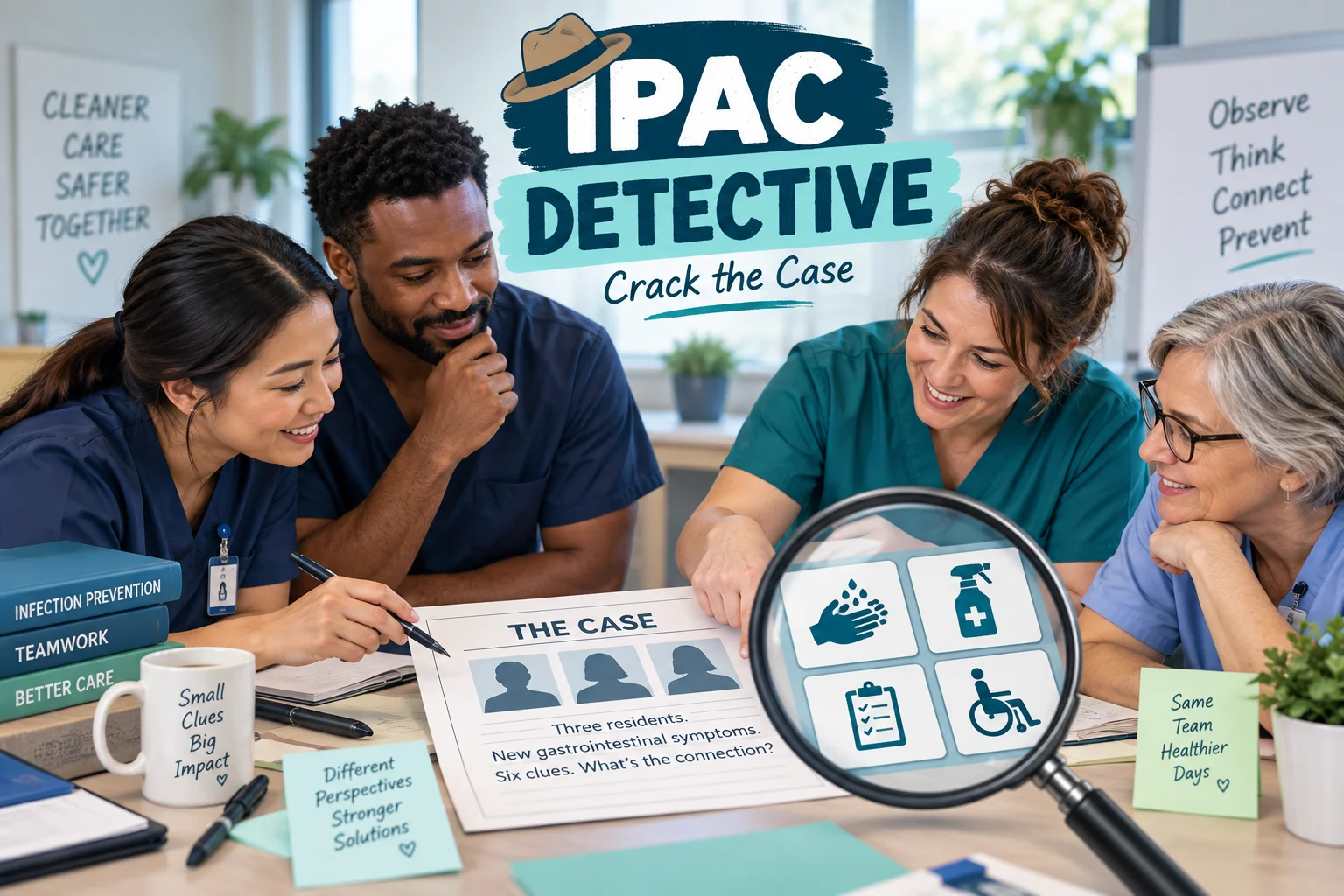
Making IPAC Education Interactive: Download Our One-Page IPAC Detective Game

Infection prevention and control education is essential in long-term care, but education should involve more than asking staff to sit through another presentation.
During a recent nursing-specific IPAC refresher workshop, staff described the experience as fun, different, engaging, and more interactive than watching a PowerPoint. That feedback highlighted something important: when staff are actively involved in their education, they have opportunities to discuss decisions, apply their knowledge, and consider how IPAC principles connect to the care they provide every day.
To help long-term care teams introduce this approach during staff huddles and education sessions, IPAC Consulting has created a free, printable IPAC Detective: Crack the Case game.
Becoming an IPAC Detective
Every staff member plays a role in recognizing and responding to infection risks. A missed cleaning record, delayed symptom report, empty hand hygiene dispenser, or shared piece of resident-care equipment may appear to be an isolated concern. However, when several concerns occur together, they may create opportunities for microorganisms to spread.
The IPAC Detective game encourages staff to examine these types of observations as a team.
Participants are presented with a fictional scenario involving three residents on the same unit who develop new gastrointestinal symptoms within a 24-hour period. Staff must review six clues and determine:
- Which findings present the greatest immediate concerns
- What possible routes of transmission should be considered
- What action should be taken first
- What system improvement could help prevent the situation from happening again
- Which clue demonstrates a positive IPAC response
The objective is not to identify a specific microorganism or assign blame. Staff must distinguish facts from assumptions, recognize potential risks, and decide how they can help interrupt transmission.
What Does the Game Reinforce?
The clues address practical situations that long-term care staff may encounter during their daily work, including:
- Prompt recognition and reporting of new symptoms
- Appropriate assessment and initiation of precautions
- Cleaning and disinfection of shared resident-care equipment
- Following the disinfectant manufacturer’s contact time
- Staff and resident hand hygiene
- Availability of hand hygiene products
- Communication between staff and departments
- Identifying system improvements instead of focusing on individual blame
These concepts support the everyday application of Routine Practices and reinforce the importance of responding promptly when new infection risks are identified.
Public Health Ontario’s Just Clean Your Hands program for long-term care also emphasizes education, accessible resources, monitoring, feedback, and organizational support as important components of a hand hygiene program.
How to Use the One-Page Game
The activity is designed to be simple to prepare and easy to include in an existing staff meeting.
- Print the game in landscape orientation.
- Fold or cut off the facilitator answer key.
- Divide staff into small teams.
- Give teams approximately 10 minutes to review the case and complete the four challenges.
- Ask each team to explain which risks they prioritized and why.
- Use the facilitator key to guide a short group discussion.
The entire activity can be completed during a staff huddle, IPAC meeting, orientation session, education day, or refresher workshop.
No presentation or special equipment is required.
Encourage Discussion, Not Just Correct Answers
The most valuable part of the activity is the discussion that happens while staff work through the case.
One team may identify delayed symptom reporting as the first priority, while another may focus on the shared commode that was not documented as being disinfected between residents. Both teams should be asked to explain their reasoning and connect their decision to resident and staff safety.
Facilitators can continue the conversation by asking:
- What information is missing from the case?
- What should the staff member do immediately?
- Who needs to be notified?
- How could the Chain of Infection be interrupted?
- What made the correct action difficult?
- Was the concern related to knowledge, communication, supplies, workload, or an unclear process?
- What could the home change to reduce the risk of recurrence?
These questions help move the conversation beyond identifying what went wrong and toward understanding how the organization can make the correct IPAC practice easier to complete consistently.
Download the Free IPAC Detective Game
Bring a quick and interactive IPAC challenge to your next staff huddle.
The one-page download includes:
- A fictional long-term care scenario
- Six clues for staff to investigate
- Four team challenges
- A 10-point scoring system
- A fold-or-cut facilitator answer key
- Suggested immediate actions and system improvements
Bring Interactive IPAC Education to Your Team
The IPAC Detective game provides a sample of the practical, discussion-based approach used in our nursing-specific IPAC education.
IPAC Consulting develops customized education and training that helps staff apply infection prevention principles to realistic situations. Our interactive workshops can address topics such as the Chain of Infection, Modes of Transmission, Routine Practices, Point-of-Care Risk Assessment, personal protective equipment, hand hygiene, symptom recognition, and cleaning and disinfection.
Have questions or want to bring interactive IPAC education to your long-term care team?
We’ve got you covered.