



How to Strengthen Your IPAC Program in 2025: A Road Map for LTC Homes
By: Youhanna Salib | BSc, CIC
If you work in a long-term care (LTC) home, you know how important infection prevention and control (IPAC) is. But with new challenges every year, such as complex regulatory requirements, it’s easy to feel overwhelmed. The good news? You don’t have to do this alone. By setting clear goals, tackling common issues, and learning from experience, you can make 2025 the year your IPAC program truly excels.
The Problem: IPAC Is Not Easy
If maintaining a strong IPAC program were easy, infections and outbreaks would not exist in long-term care homes. Unfortunately, there several issues that stand in the way of a strong IPAC program:
- Complex regulations that add pressure to the program, making it more challenging to build a no-blame culture in your home
- Not enough staff, making it hard to build consistent knowledge and expertise in your LTC home. This becomes especially problematic when staff turnover is high
- Limited resources and funding, which makes it even more challenging to invest into the IPAC program and improve it
The Plan: Set Clear Goals
Despite the challenges mentioned above, a strong IPAC program can still be built in your LTC home. Start by setting specific, measurable goals such as:
- Train your team with regular, engaging education sessions. Plan your educational plan ahead, as it will help you build the necessary knowledge in your home
- Reduce infection rates by creating a detailed action plan that reinforces the necessary IPAC practices. Make sure to track your progress to understand whether your interventions are working
- Update policies to ensure that you and your team are up-to-date on the latest regulatory requirements and IPAC best practice guidelines
The Solution: Learn from the Past
When you take a proactive approach, your IPAC program stops being a source of stress. Here’s how:
- Review past outbreaks to uncover patterns, gaps in practice, and stop them from happening again.
- Learn from others by adopting strategies that have worked in other homes.
- Listen to your staff, the people on the front lines who know what’s working—and what’s not. Make sure you engage your staff and ask for their feedback often.
Next Steps: Take Action Now
Don’t let another year go by without making real progress. Here’s how you can start today:
- Set clear, measurable goals to keep your IPAC program on track.
- Build your team with training that’s practical and engaging.
- Understand gaps in practice that were identified in the previous years, and set a clear goal to tackle them this year
- Get expert help from an IPAC professional who understand the challenges you face and can assist you in building the IPAC culture you are thriving for.
Still don’t know where to start? Book our IPAC Compliance Program and our team of expert can help you evaluate your IPAC program and set goals for the new year.
You’ve worked too hard to let challenges derail your progress. This year let’s take control of your IPAC program and create a safer environment for residents and staff.

Get Ready for Construction Season! The Cost of Overlooking Infection Control in Healthcare Projects
By: Jacob Whittock | BSc, PMP
Healthcare construction projects are intricate undertakings where every detail impacts safety, efficiency, and compliance. Yet, infection prevention and control (IPAC) is often overlooked until it’s too late. Ignoring IPAC considerations during the early planning and design phases can lead to costly mistakes, delays, and operational inefficiencies. That’s why involving IPAC Consulting and our tailored Infection Control Risk Assessment (ICRA) early in your project is essential.
Infection control is not just a regulatory checkbox—it’s the cornerstone of patient and staff safety in healthcare environments. Delaying the inclusion of infection control expertise can have significant consequences. Retrofitting spaces to meet infection control standards after construction is far more expensive than integrating these measures from the start. Project delays caused by redesigns can stall a facility’s readiness to provide care, while inadequate infection control measures put patients, staff, and your organization’s reputation at risk.
At IPAC Consulting, we specialize in seamlessly integrating infection control into your project’s foundation. Our Infection Control Risk Assessment (ICRA) is a proactive solution that identifies risks, streamlines processes, and ensures compliance with infection control standards. We provide blueprint and drawing reviews to propose design adjustments, such as optimizing airflow, minimizing contamination risks, and ensuring proper placement of hand hygiene stations. Our tailored policies and protocols ensure that your project remains compliant and operationally efficient long after construction is complete. Failing to plan for infection control early can inflate budgets, disrupt timelines, and result in compliance violations. In contrast, engaging IPAC Consulting at the outset ensures your project avoids these setbacks, opening on time and within budget while safeguarding patients and staff. Proactive planning reduces costs, mitigates risks, and helps you meet health and safety standards efficiently.
Healthcare facilities that prioritize early IPAC involvement create environments that are safe, functional, and compliant. By collaborating with IPAC Consulting, you’ll build a facility that reflects the highest standards of infection prevention and control from day one. Let us help you save time, money, and stress while delivering a project that prioritizes safety and operational excellence. Together, we can create healthcare spaces where safety is embedded in every detail—from the ground up.

Planning for the Year Ahead: Elevating IPAC in Cosmetic Surgery Clinics
By: Lauren Lebre | BSc, MHSc
As we wrap up January and start fresh into the new year, it’s the perfect time to hit “refresh” on your clinic’s Infection Prevention and Control (IPAC) practices. It’s never too late to make New Year’s resolutions—especially when it comes to keeping your patients and staff safe.
In cosmetic surgery, where patients trust you with their health, IPAC is not just a compliance box to check; it’s the backbone of your clinic’s success. With the ever-present risk of infections, taking a proactive, forward-thinking approach to IPAC can make all the difference. This requires all encompassing aspects of a clinic like policies, procedures and practices.
Common Gaps in IPAC Practice
Even the best clinics can miss a few key details when it comes to IPAC, leaving room for potential risks. One of the biggest gaps? Inadequate sterilization practices. Whether it’s improperly sterilized surgical tools or cross- contamination between contaminated materials, these lapses could lead to infections that are harmful to patients and damaging to your clinic’s reputation.
Another challenge is the lack of ongoing training for staff. It is important to understand that IPAC practices evolve, and your team needs to stay on top of the latest guidance’s. After all, staying up-to-date means everyone, so staff know exactly what they should be doing to keep the clinic safe. Plus, not documenting policies and procedures properly could leave your clinic vulnerable to sterilization recalls and ministry inspections.
The Risks of Poor Practices
Neglecting IPAC can have serious consequences. Infections aren’t just a risk for your patients—but poor IPAC practices can lead to severe complications, extended recovery times, and reputational damage that could affect your clinic for years to come.
Proactive Steps to Protect Your Clinic
The good news is, there’s a lot you can do to improve and monitor your clinic’s IPAC practices. Start by implementing regular audits—check in on your sterilization processes, review protocols, and do a complete clinic assessment. This proactive approach not only ensures you’re complying with the latest guidelines, but it also gives your staff the confidence that they’re doing things the right way.
Ongoing education is also essential to ensure staff are up to date with any new IPAC guidelines. And foster a culture where everyone, regardless of their role, adheres to IPAC best practices.
Documentation of policies and procedures is also crucial. Keep detailed records of all your infection control protocols and regularly review them through a clinic assessment. This demonstrates that you’re taking all the right steps to prevent infections and maintain a safe clinic environment.
The Long-Term Perks of an IPAC Program
Strengthening your IPAC practices isn’t just about avoiding infections—it’s about building a safer, more efficient clinic where patients feel cared for and confident in your services. A strong IPAC program not only reduces the risk of infection but also improves overall patient outcomes, which means better reviews, more referrals, and happier clients.
So, as you start to make new year’s resolutions, remember that IPAC isn’t just a “one-time thing” but an ongoing commitment. By staying proactive and addressing common gaps—you’re setting yourself up for long-term success.

New Year, New Inspections: Proactive Measures for Stress-Free Inspections
By: Michael Streicher | BPH, BEPH, LTC-CIP
In the dynamic field of dental healthcare, maintaining robust IPAC practices is essential to safeguarding the health of both patients and staff. For dental offices in Ontario, implementing a comprehensive IPAC policy manual is more than just a best practice—it’s an absolute requirement.
A well-crafted IPAC policy manual serves as the cornerstone of any dental practice’s commitment to safety and compliance. It provides clear guidelines for staff, ensuring that everyone follows the same rigorous standards set by regulatory bodies such as the Royal College of Dental Surgeons of Ontario (RCDSO) and Public Health Ontario. These policies cover crucial aspects like proper hand hygiene, medical device reprocessing, and environmental cleaning protocols.
The consequences of not having clear IPAC policies can be severe.
In a recent case, a dental office in Toronto, Ontario, faced a public health crisis when it was discovered that patients may have been exposed to improperly sterilized instruments due to a staff miscommunication. This led to a recommendation for all patients to undergo testing for serious bloodborne infections and scrutiny from Toronto Public Health.
Such incidents not only jeopardize patient health but also damage the reputation of your practice and can result in legal repercussions.
When you partner with us, we significantly ease the burden of creating and maintaining these critical policies. Our team of IPAC Consultants ensures that your practice stays up-to-date with the latest guidelines, reducing the stress and anxiety associated with Ministry of Labour (MLITSD) and college (RCDSO) inspections. With our professionally developed policy manual, dental practices and dentist-owners can confidently navigate regulatory inspections, knowing they have done their due diligence.
Remember, it’s always better to be proactive than reactive when it comes to compliance. By investing in a comprehensive IPAC policy manual, dental practices can avoid potential costly shutdowns, and reputational damage. More importantly, it provides peace of mind, knowing that your practice is doing everything possible to protect your patients and staff.
A robust IPAC policy manual not only ensures compliance with regulatory standards but also demonstrates your commitment to excellence in patient care.
With the support of IPAC Consulting, our dental clients can confidently face inspections and focus on what they do best—providing top-quality dental care to their patients.

Introducing:
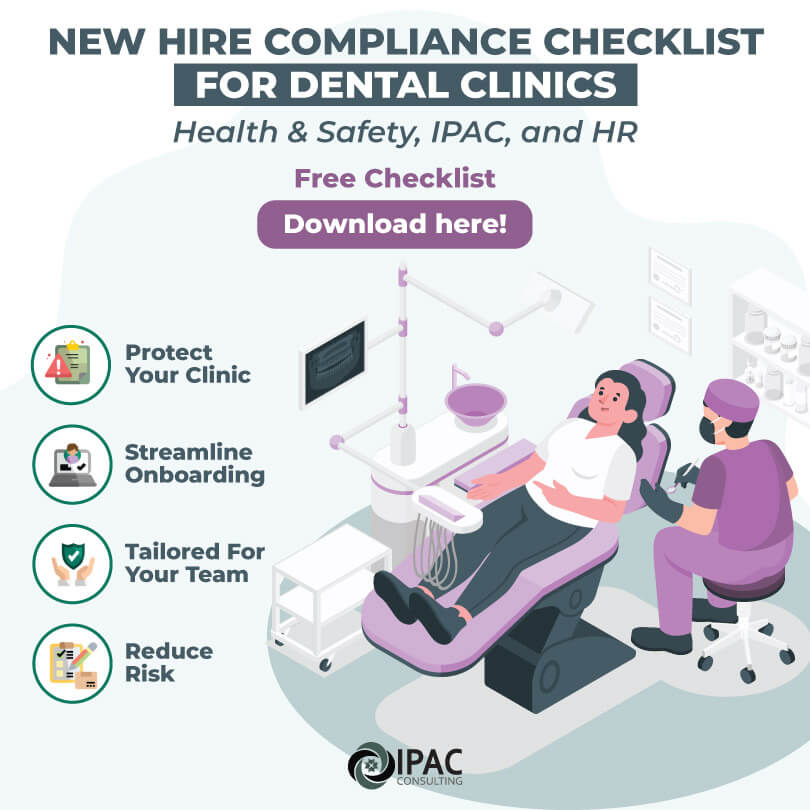
New Hire Compliance Checklist for Dentistry!
Let us take the guesswork out of onboarding with our New Hire Compliance Checklist – a ready-to-use tool that ensures your dental team meets all regulatory requirements.
Want to see how it works?
Get a free sample new hire checklist tailored for dental clinics.

Our expert consultants have designed top-quality products and services for you!
Meeting complex regulatory requirements can feel overwhelming, but our streamlined 4-Phase IPAC Compliance Program is designed to simplify the process and ensure the success of your infection control program. With year-long support, we guide your facility every step of the way. Learn more here!
Our Our Infection Control Risk Assessment helps you stay ahead by proactively managing infection risks and ensuring Ministry due diligence in your construction and renovation projects. From schematic design to development, our experts work with your team to identify and mitigate infection control risks early, providing the expertise needed for a successful project. Our Design Phase ICRA Consultation goes beyond industry standards—it ensures compliance with Ministry expectations while prioritizing patient safety. Learn more here!

With our Personalized IPAC Policy & Procedure Manual for Dental Offices, you’ll stay aligned with governing body standards effortlessly. Enjoy a hard-copy manual and an online version that updates in real time—compliance has never been simpler for the dental industry! Learn more here!
Ensure your cosmetic surgery clinic is meeting the highest infection control standards with our General Office Assessment. Led by a certified IPAC Consultant, this service audits your policies, procedures, training, and physical spaces, providing a thorough analysis and actionable recommendations for improvement. Learn more here!