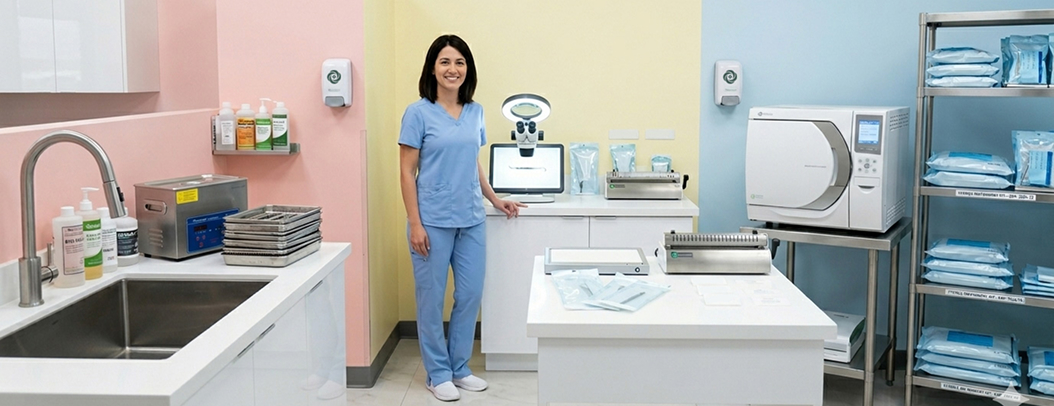
Would It Blow Your Mind If I Told You There Are Three Distinct Sections for Reprocessing?

It might sound basic. It might even sound obvious. But in dental practices across Ontario, one of the most frequently misunderstood—and inconsistently implemented—concepts in infection prevention and control is this:
Reprocessing is not one space. It is three clearly defined sections.
• Dirty
• Clean
• Sterile
And how well these three areas are understood—and physically separated—can make or break your compliance with Public Health Ontario guidance and RCDSO standards.
Why This Matters More Than You Think
Reprocessing isn’t just about sterilizing instruments. It’s about preventing cross-contamination at every step. Public Health Ontario and the Royal College of Dental Surgeons of Ontario (RCDSO) are very clear:
• Reprocessing must follow a one-way workflow.
• Instruments must move from dirty → clean → sterile.
• There must be physical or clearly defined separation between these areas.
Yet in practice, many clinics unintentionally blur these lines.
Section 1: The DIRTY Area
This is where contaminated instruments begin their journey.
What happens here:
• Receiving used instruments
• Sorting and disassembly
• Cleaning (manual or ultrasonic)
Key risks:
• Splashing, aerosols, sharps injuries
• High bioburden (blood, saliva, debris)
What the guidelines emphasize:
• This area must be clearly separated from clean and sterile spaces.
• Appropriate PPE is required.
• Cleaning must occur before any sterilization step.
Bottom line: This is the highest risk zone in reprocessing.
Section 2: The CLEAN Area
This is where many practices start to lose clarity. Once instruments are cleaned, they move into the clean zone—but they are not sterile yet.
What happens here:
• Inspection for cleanliness and damage
• Drying
• Packaging and wrapping
• Preparation for sterilization
Key risks:
• Recontamination from dirty workflows
• Mixing clean and contaminated items
What PHO and RCDSO expect:
• A dedicated space separate from dirty processing.
• Clean instruments must never come into contact with contaminated surfaces or instruments.
Bottom line: This is the transition zone—and it must be protected.
Section 3: The STERILE Area
This is the final stage—the goal of the entire process.
What happens here:
- Sterilization (autoclave)
- Cooling and drying
- Storage of sterile instruments
Key risks:
- Improper storage
- Handling that compromises sterility
- Mixing with non-sterile items
Standards require:
- A designated area for sterile storage.
- Protection from moisture, dust, and contamination.
- Clear separation from both clean and dirty zones.
Bottom line: Sterile means ready for patient use—without compromise.
Where Things Go Wrong
Even in well-run practices, we commonly see:
• Overlapping zones (e.g., cleaning and packaging in the same space)
• Instruments moving back and forth instead of one-way
• Lack of physical barriers or clear workflow direction
• Clean and dirty items sharing countertops
These aren’t just workflow issues—they are compliance risks.
One-Way Flow: The Core Principle
Both Public Health Ontario and the RCDSO emphasize a simple but critical concept : Reprocessing must move in one direction only.
Dirty > Clean > Sterile
It should not move:
- Backwards
- Sideways
- Or “wherever there’s space”
Even in smaller clinics, clear separation (physical or procedural) is expected.
What This Means for Your Practice
Ask yourself:
- Do we have clearly defined dirty, clean, and sterile areas?
- Can instruments ever cross paths in the wrong direction?
- Is our team consistent in following the workflow?
- Would an inspector easily identify each zone?
If there’s hesitation in any answer—it’s worth reviewing.
Final Thoughts
So—would it blow your mind? Maybe not. But what should stand out is this:
• Reprocessing isn’t just about sterilization.
• It’s about structure, flow, and separation.
Dirty. Clean. Sterile. Three distinct sections. One critical standard. Zero room for shortcuts.
Because in dentistry, patient safety depends on what happens behind the scenes just as much as what happens chairside.
Need help identifying your clinic’s IPAC gaps?
IPAC Consulting supports dental clinics with IPAC audits, Sterilization Review and Audit, General Office Assessments, policy manuals, staff education, MIFU and SDS organization, and the IPAC Dashboard. Our goal is to help your team move from “we think we are doing this correctly” to “we can confidently show how our system works.”