Why Some Dental Offices Stay Stuck in “Fixing Things” Mode, and How to Identify the Gaps That Matter Most

Most offices do not struggle because they do not care about compliance. They struggle because it can be difficult to step back and clearly see where the real risks are.”
Working in infection control, I have spent a lot of time in dental offices of all sizes — high-performing practices, newer offices still building structure, and long-established teams doing their best to keep everything moving.
And one thing has become very clear to me:
Most offices do not struggle because they do not care about compliance. They struggle because it can be difficult to step back
and clearly see where the real risks are.
In many offices, the issue is not one major failure. It is the presence of smaller gaps that go unnoticed or unprioritized over time.
A missing log here.
An inconsistent process there.
A policy that exists, but no longer reflects what is actually happening in practice.
A team member doing something “the way we’ve always done it,” without realizing the standard has changed.
On their own, these things may seem minor. Together, they can point to larger weaknesses in how an office is functioning.
The hardest part is not finding gaps. It is knowing which ones matter most.
Most offices already have a sense of the areas they want to strengthen: sterilization flow, reprocessing documentation, hand hygiene, environmental cleaning, PPE protocols, training consistency, policy review, and staff accountability.
The challenge is not always awareness. Often, it is knowing where to begin. When that becomes unclear, offices tend to do one of two things: they focus on what is easiest to fix, or they delay action because they are unsure what should come first.
Risk should not be prioritized by what is most visible, most frustrating, or most convenient. It should be prioritized by what has the greatest potential impact on safety, compliance, and consistency.
Not every gap carries the same weight.
This is one of the most important mindset shifts a dental office can make: a gap is a gap — but not all gaps are equal.
If everything is treated as equally urgent, teams lose focus.
An outdated label on a binder is not the same level of risk as a breakdown in reprocessing workflow. A document filed in the wrong place is not the same as staff being unclear on when and how to use PPE. A form that looks messy is not the same as having no clear process for exposure response.
The better questions are: what creates the highest risk if left unaddressed? What affects patient safety most directly? What would create the greatest concern during an inspection? What issue, if repeated daily, could lead to the biggest long-term consequence?
The offices that improve most effectively usually do one thing well.
These are the signs that tell you whether a system is truly functioning — or simply being held together by habit.
They stop looking at compliance as a collection of separate tasks and start looking at the office as a system. That means asking: where are we relying on memory instead of process? Where are we assuming consistency instead of verifying it? Where does our documentation not match our actual workflow?
Because gaps are not always dramatic. Sometimes they show up in subtle ways:
The team answers the same question three different ways.
Logs are completed, but not consistently reviewed.
Supplies are available, but not at the point of use.
Policies exist, but staff are unsure how they apply in practice.
These are the signs that tell you whether a system is truly functioning — or simply being held together by habit.
If you want a clearer picture of your risks, start here
- Focus first on high-impact workflows — reprocessing, environmental cleaning, hand hygiene, PPE use, sharps handling, and exposure response.
- Compare what is written to what is actually happening. A process is only strong when policy, training, and practice align.
- Pay attention to inconsistency. When staff do the same task in different ways, it often points to a lack of clarity or structure.
- Separate what is important from what is urgent. Not every issue needs to be fixed today — but some absolutely do.
A stronger office is not an office with zero gaps. It is an office that knows where its gaps are, understands which ones matter most, and has a clear plan to address them.
“Where are we vulnerable?“
Because when you start identifying gaps honestly and prioritizing risks intentionally, compliance becomes more than a checklist. It becomes a way of running a safer, stronger, more consistent practice.
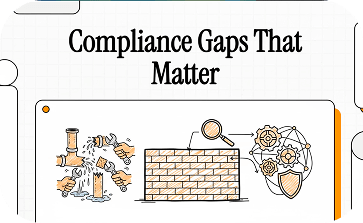
Your clear path starts here
We created a short resource for dental offices on how smaller compliance gaps build over time, which ones carry the most weight, and how stronger offices prioritize risk more intentionally.
Stronger offices are built on stronger systems
After 13 years of working with dental clinics, we have seen firsthand that stronger compliance does not come from storing more information.
It comes from having clearer structure behind the program, so offices can spot vulnerabilities earlier, prioritize risk more effectively, and keep documentation, training, and workflow better aligned.